Maximise your energy independence and slash your monthly utility bills by storing your own solar power.
Home » Eltom Solar PV And Battery Storage
Battery storage systems allow households to store electricity when it’s cheapest and use it when energy prices are higher.
By installing a domestic battery storage system, your home can automatically charge using
cheaper off-peak electricity from the grid – typically overnight – and use that stored power
during the day when tariffs are more expensive.
With smart controls and increasing flexibility in energy tariffs, battery storage is becoming an
increasingly popular solution for households looking to reduce energy costs and future-proof
their home.
Installing a home battery storage system offers a range of financial and practical benefits:

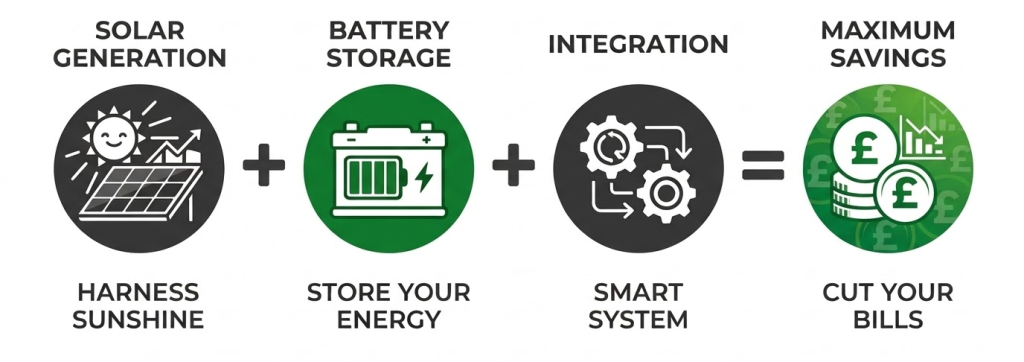
A home storage battery stores electricity so you can use it when you need it, rather than relying entirely on power from the grid.The battery charges using electricity from your mains supply, often during cheaper off-peak periods on time-of-use tariffs. The stored energy can then be used later in the day when electricity prices are higher, helping to reduce your household energy costs. Some home batteries can also work alongside solar panels, storing any excess solar energy for use later, but they can operate perfectly well as a stand-alone system connected to the grid.
Most modern home storage batteries are designed to last 10–15 years, depending on how often they are used and the quality of the system installed. Many leading battery manufacturers provide warranties of 10 years or more, which typically guarantee a certain level of performance or energy capacity over time. This gives homeowners confidence that the system will continue to deliver reliable savings for many years. If you later install solar panels, the same battery can often be used to store excess solar energy as well, helping you get even more value from your system.
Yes. Most professionally installed home storage batteries come with a manufacturer’s warranty of around 10 years, with some systems offering 12–15 years of cover depending on the brand. These warranties usually guarantee that the battery will maintain a minimum level of performance over time (for example, retaining around 60–80% of its original capacity after
the warranty period).
No. Home storage batteries can be installed without solar panels and work as a stand-alone system connected to the grid. In this setup, the battery typically charges using cheaper off-peak electricity, often overnight on time-of-use tariffs. The stored energy can then be used during the day or evening when electricity prices are higher, helping to reduce your energy bills.
The right battery size depends on how much electricity your home uses and when you use it. For most households, the aim is to choose a battery that can store enough lower-cost electricity to cover your higher-cost usage later in the day. A system that is too small may not deliver the savings you want, while one that is too large could mean paying for storage capacity you do not fully use. The best size will usually depend on factors such as your household’s energy usage, tariff and available installation space. A home survey can help identify the most suitable battery
capacity for your property and budget. Book a home survey with Eltom Electrical.
Home storage batteries are usually installed inside the property or in an attached garage, where they are protected from extreme temperatures and weather. Common installation locations include garages, utility rooms, cupboards, or other indoor storage areas with suitable wall space and ventilation. In some cases, batteries can also be installed in lofts or outdoors in weatherproof enclosures. Eltom Electrical can assess your home and recommend a safe, practical location that meets installation standards and allows easy access for maintenance if needed. Book a home survey with Eltom Electrical.
Yes, it is possible to charge an electric vehicle (EV) using electricity stored in a home battery. In most cases, the battery stores lower-cost electricity from the grid during off-peak periods. This stored energy can then be used to help power your home or contribute towards EV charging later in the day, potentially reducing the cost of charging your vehicle. If you have or plan to install an EV charger, a home survey can help determine the best battery size and setup to support both your home’s energy needs and EV charging. Book a home survey with Eltom Electrical.
In most cases, planning permission is not required to install a home storage battery inside your property. Batteries installed in locations such as garages, utility rooms or other indoor spaces are typically considered permitted development. However, installations must still comply with UK
electrical and building regulations, and should always be carried out by a qualified installer. If the battery is installed externally or in a listed building, planning requirements may vary, so it’s worth checking with your local authority. The team at Eltom Electrical can advise on any permissions needed and ensure the system is installed safely and in line with current standards.
Battery storage allows you to store excess electricity generated by your solar panels instead of sending it straight to the grid.
During the day, your solar panels generate electricity for your home. If you produce more electricity than you need at that time, the surplus can be stored in a home battery. You can then use this stored energy later, such as in the evening or at night when your panels are no longer generating power.
A DNO (Distribution Network Operator) is the company responsible for operating and maintaining the local electricity network in your area.
In the context of home solar PV, the DNO manages how electricity systems connect to the grid. When a solar PV system is installed, Eltom Electrical will notify the DNO or apply for permission to connect the system to the local electricity network.
Yes. In the UK, the Distribution Network Operator (DNO) must be informed when a solar PV system is installed and connected to the electricity network. Eltom Electrical will handle this process for you.
A home solar PV system can generate electricity that can be used to charge an electric vehicle (EV).
During the day, your solar panels produce electricity that can power your home or be used to charge your car through a compatible EV charger. Some smart chargers can also prioritise using solar energy when it is available. You can also pair your home solar Array with a battery storage solution, allowing you to store solar energy that can be used to charge your EV and power your home.
No. Home solar panels do not require batteries to work.
A solar PV system can generate electricity for your home without battery storage. Any excess electricity that you do not use at the time can be exported to the grid.
Batteries are an optional addition that allow you to store unused solar electricity and use it later.
Home solar panels generally require very little cleaning or maintenance.
In the UK, rainfall usually helps to wash away dust, pollen and other debris that may accumulate on the panels. In most cases, this is enough to keep them operating efficiently.
However, if panels become heavily soiled — for example from bird droppings, leaves or nearby trees — occasional cleaning may help maintain performance.
In most cases, planning permission is not required to install solar panels on a residential property in the UK.
Solar panels are usually considered a permitted development, provided they are installed in a way that minimises their visual impact and do not extend significantly beyond the roof surface.
However, planning permission may be required if your property is a listed building, located in a conservation area, or if the installation does not meet permitted development guidelines.
In most cases, planning permission is not required to install solar panels on a residential property in the UK.
Solar panels are usually considered a permitted development, provided they are installed in a way that minimises their visual impact and do not extend significantly beyond the roof surface.
However, planning permission may be required if your property is a listed building, located in a conservation area, or if the installation does not meet permitted development guidelines.
In most cases, installing a home storage battery does not significantly affect your home insurance premium. However, you should always inform your insurer once the system is installed. Insurers consider technologies such as battery storage to be a material change to your property, so they need to know about the installation to ensure your home remains fully covered.
No. Home storage batteries should not be installed as a DIY project. Battery systems connect directly to your home’s electrical supply and must comply with UK electrical and safety regulations. Installation involves specialist equipment, system configuration and testing to ensure the battery operates safely and efficiently.
For this reason, home storage batteries should always be installed by a qualified professional installer.
The cost of a home storage battery in the UK typically ranges from around £3,000 to £10,000, depending on the battery size, brand and installation requirements.
For many households, a typical system costs around £3,000–£8,000 fully installed, although smaller systems can cost less and larger or premium systems may cost more.
A home survey is usually needed to provide an accurate quotation, as the best battery size and setup depends on your home’s energy use and tariff. Book a free home survey.
Home storage batteries require very little maintenance. In most cases, maintenance simply involves occasionally checking the system app or display to ensure everything is operating normally and keeping the installation area clean, dry and well ventilated.
Yes. Modern home storage batteries are designed with multiple built-in safety features to ensure safe operation in residential properties. Most systems use advanced lithium-ion technology with a battery management system that constantly monitors temperature, charging and performance.
If any issue is detected, the system can automatically adjust or shut down to protect the battery and your home. When installed by a qualified professional and in line with UK electrical standards, home storage batteries are considered very safe and reliable.
Eltom Electrical can recommend an appropriate location and ensure the system is properly ventilated and protected, helping the battery operate safely for many years.
The savings from a home storage battery depend mainly on your electricity tariff and how much energy your household uses.
Many homeowners use battery storage to charge with cheaper off-peak electricity and then use that stored energy when prices are higher.
For some households, this can mean hundreds of pounds in annual electricity savings, although the exact amount will vary depending on your energy usage, tariff and the size of the battery installed.
A home survey and energy assessment can help estimate the potential savings for your property and recommend the most suitable battery system. Book a free home survey.
Yes. In many cases, a storage battery can be added to an existing solar panel system. The exact setup will depend on your current solar system, inverter and available space for the battery. Eltom Electrical can assess your existing system and recommend the best way to integrate battery storage. Learn more about home solar PV.
Yes. In the UK, the Distribution Network Operator (DNO) must be notified when certain energy systems, including home storage batteries, are connected to the electricity network. The exact process depends on the size and type of system. Smaller systems may only require notification after installation, while larger systems may need approval before installation (often referred to as a G99 application).
Eltom Electrical will manage the DNO notification or application as part of the installation process.
G99 approval is a process required for some home energy systems that connect to the electricity grid. In the UK, your local Distribution Network Operator (DNO) manages the electricity network in your area. If a battery system can export electricity back to the grid above certain limits, the
installer may need to apply for G99 approval from the DNO before the system can be installed.
Homeowners do not need to deal with this themselves. Eltom Electrical will handle the application and approval process with the DNO as part of the installation.
No. A smart meter is not required to install or use a home storage battery. However, having a smart meter can help you get the most value from the system, as it allows you to access time-of-use electricity tariffs where prices are cheaper at certain times of day. This makes it easier to charge the battery when electricity is cheaper and use the stored energy later.
Yes, it can be — but the savings are usually smaller than with solar panels. A standalone home battery can help reduce electricity costs by charging with cheaper off-peak electricity (often overnight) and using that stored energy during the day when electricity prices are higher.
While pairing a battery with solar usually increases the savings, a stand-alone battery can still help you use electricity more efficiently and reduce peak-rate energy costs.
In most cases, no —installing a home storage battery will not affect your Feed-in Tariff (FiT) payments. FiT payments are based on the electricity your solar panels generate, not how the electricity is used. This means you can still receive your generation payments even if you store some of that energy in a battery.
Looking to invest in commercial solar panels? We’ll help you maximize energy efficiency and long-term savings